what is division of labour in cells Cells: division of labour
Hey there! Let’s talk about the fascinating concept of division of labour in both biological and mechanical systems. It plays a crucial role in enhancing efficiency and functionality. So, buckle up and let’s dive into the world of teamwork!
Cell the Unit of Life Part: Biology Class 11 NCERT Solutions
 In the world of biology, cells are the foundation of life. They are like tiny factories with specialized tasks assigned to different components. This incredible phenomenon is known as “division of labour.” Each organelle within a cell has a specific function, contributing to the overall functioning and survival of the organism.
For example, the nucleus is like the control center of a cell, responsible for storing genetic information. The mitochondria are like powerhouses, producing energy for the cell. Likewise, every organelle, from the endoplasmic reticulum to the Golgi apparatus, plays a crucial role in maintaining the cell’s functionality.
Just like a well-oiled machine, the division of labour ensures that each part focuses on a specific task, leading to efficient and effective cellular processes. This principle is vital for the smooth functioning and survival of all living organisms.
Origin of Mechanosensory-Contractile Circuits
 Now let’s shift our focus to an intriguing concept beyond the realm of biology - the origin of mechanosensory-contractile circuits through division of labour. It has been hypothesized that certain mechanical systems, such as the musculoskeletal system, function effectively due to the distribution of specific tasks among individual components.
Just like in a cell, where organelles specialize in particular functions, mechanical systems exhibit a division of labour to optimize performance. In the case of mechanosensory-contractile circuits, different entities work in unison to detect and respond to external mechanical stimuli, such as touch or pressure.
For instance, in the human hand, sensory receptors send signals to the brain, which then instructs the muscles to contract or relax, resulting in precise movements. This intricate dance between various components enables us to perform complex tasks effortlessly.
By harnessing the power of division of labour, both biological and mechanical systems achieve remarkable efficiency and functionality. It is a testament to the power of teamwork in solving complex problems and adapting to our ever-changing world.
So, the next time you marvel at the wonders of life and the incredible machines we create, remember the underlying principle of division of labour. It’s the secret ingredient that allows organisms and machines alike to function seamlessly.
Keep exploring and embracing the beauty of teamwork!
If you are searching about Cell: Division of Labour - YouTube you’ve visit to the right web. We have 5 Pics about Cell: Division of Labour - YouTube like Cell: Division of Labour - YouTube, PPT - Cells (Division of Labour ) PowerPoint Presentation, free and also Biology Class 11 NCERT Solutions: Chapter 8 Cell the Unit of Life Part. Here you go:
Cell: Division Of Labour - YouTube
 www.youtube.comOrigin Of Mechanosensory-contractile Circuits By Division Of Labour
www.researchgate.netmechanosensory labour circuits contractile hypothesized sensory
PPT - Cells (Division Of Labour ) PowerPoint Presentation, Free
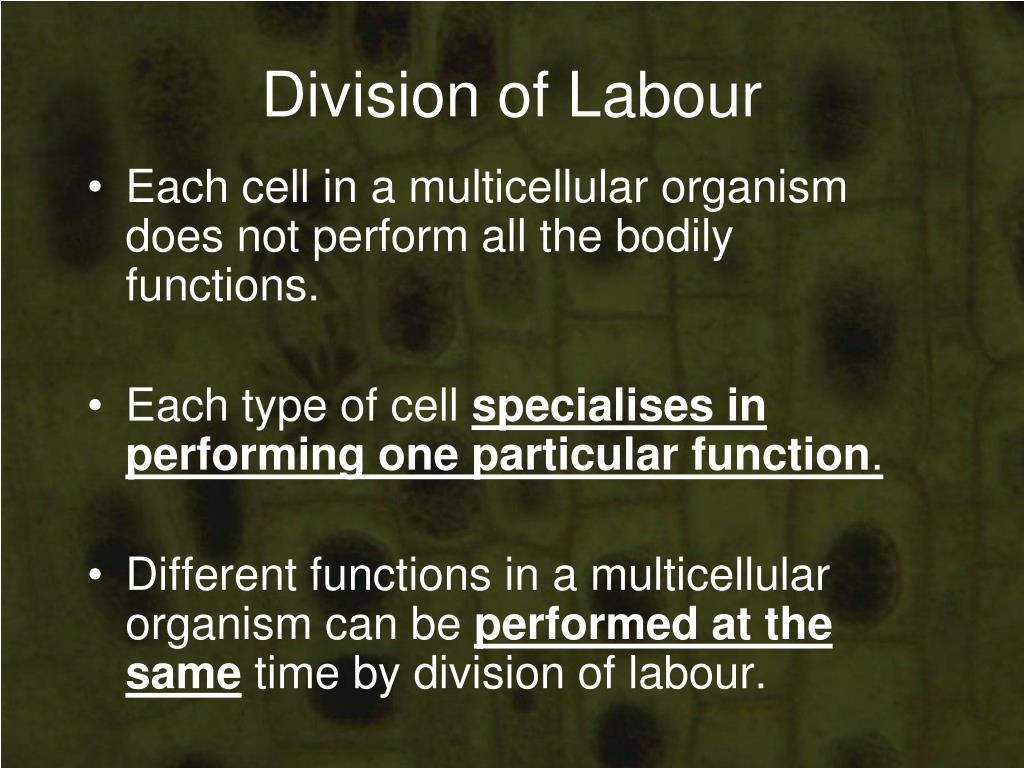 www.slideserve.comdivision labour cells organism multicellular cell ppt powerpoint presentation does
Cells: Division Of Labour - YouTube
 www.youtube.comdivision labour cells
Biology Class 11 NCERT Solutions: Chapter 8 Cell The Unit Of Life Part
www.flexiprep.comdivision labour biology cell ncert solutions unit class part life cells organism shows flexiprep organisms multicellular chapter
Mechanosensory labour circuits contractile hypothesized sensory. Division labour biology cell ncert solutions unit class part life cells organism shows flexiprep organisms multicellular chapter. Division labour cells organism multicellular cell ppt powerpoint presentation does